
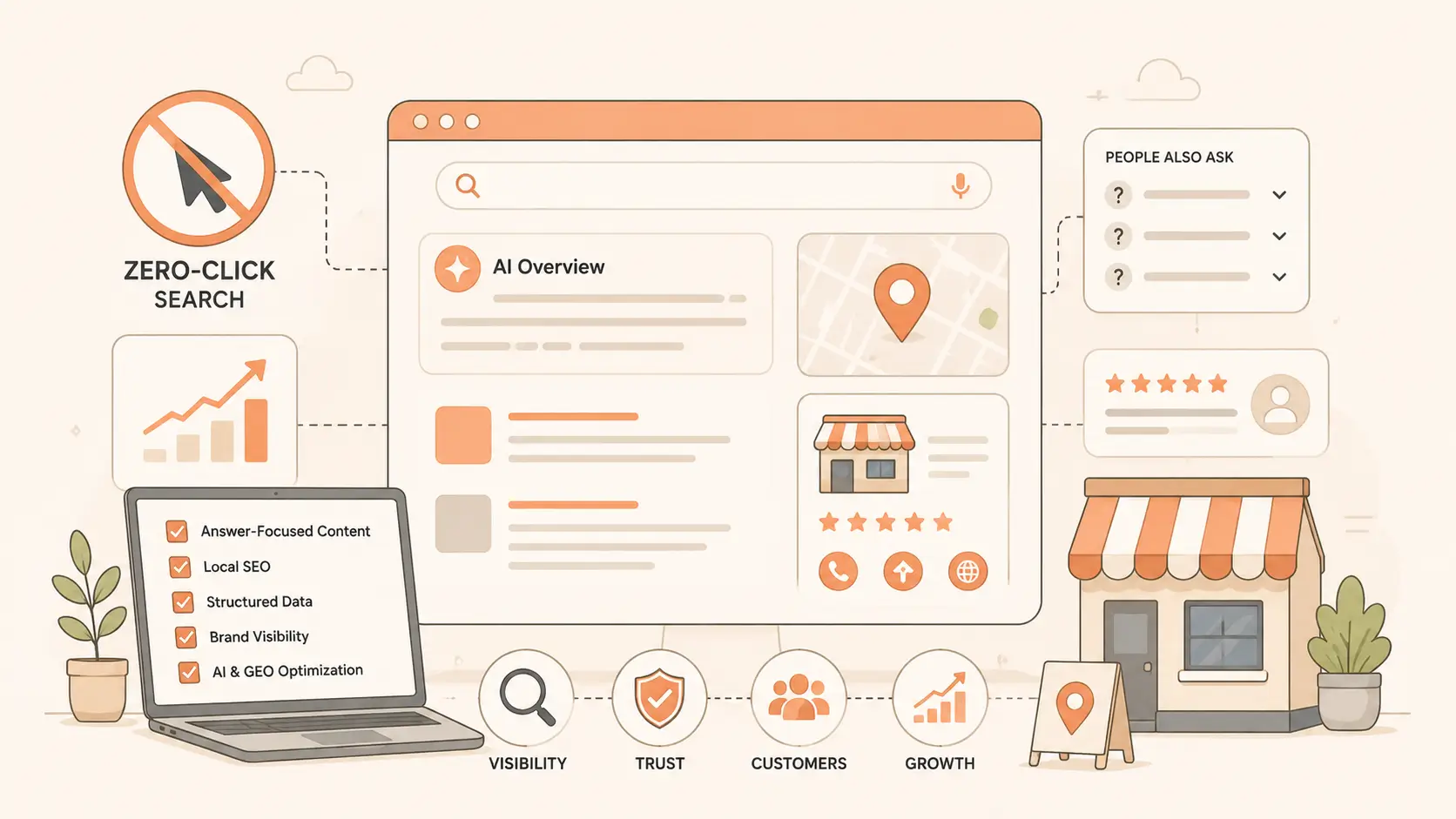
For two decades, search engine optimization had one job: get the click. Rank higher, earn more visits, convert more of those visits into customers. That model is now half-broken. In 2026, the majority of Google searches end without anyone clicking through to a website at all. For small businesses watching their organic traffic charts slope downward, this feels like a crisis. It isn't—but the businesses that keep treating SEO as a pure traffic game will lose to the ones that adapt.
This guide explains what zero-click search actually means for a small business, why it's less of an emergency than the headlines suggest, and exactly what to do about it.
What "Zero-Click" Really Means Now
A zero-click search is one where the user gets their answer directly on the results page—from an AI summary, a featured snippet, a map pack, a knowledge panel, or a "People Also Ask" box—and never visits an external site.
The scale of this has crossed a tipping point. Independent research from Datos and SparkToro puts the share of Google searches ending without an outside click at roughly 58–60% in the US and EU. The single biggest accelerant is Google's AI Overviews, the AI-generated answer block that now sits at the top of a large slice of results pages. AI Overviews expanded from covering a small fraction of queries in mid-2024 to well over half of all queries by early 2026, and searches that trigger them show dramatically higher zero-click rates—on the order of 80%+—than traditional results.
The knock-on effect on clicks is real. When an AI Overview appears, the average page targeting that keyword sees its click-through rate fall by roughly a third, and top organic positions can lose far more. Gartner's earlier forecast that traditional search volume would drop around 25% by 2026 as users shift to AI assistants now looks conservative rather than alarmist.
That's the bad news. Here's the part most coverage skips.
Why This Is Not the End of SEO
Zero-click search is asymmetric. It does not hit all content equally, and understanding the split is the foundation of any sensible 2026 strategy.
What AI Overviews absorb well: commodity informational content. Generic definitions, basic how-to explainers, standard listicles, "what is X" queries. If a large language model can synthesize the answer from a dozen interchangeable pages, it will—and your blog post on "what is a Roth IRA" or "how long to boil an egg" is no longer a traffic source.
What survives and even benefits: anything that requires the user to actually arrive at your site to get the value. Product and service pages. Local businesses people need to call, visit, or book. Interactive tools and calculators. Downloadable resources. Original research and proprietary data. Expert analysis with a real point of view. These are not easily flattened into a three-sentence summary.
The strategic reframe is this: SEO has shifted from a traffic channel to a visibility and trust channel. The goal is no longer only "get the click." It's also "be the brand that gets mentioned, cited, and recommended"—on the results page, inside AI Overviews, and within answers from ChatGPT, Perplexity, Gemini, and Claude. For local businesses in particular, appearing in a zero-click local answer often produces higher-intent leads, because the people who do reach out have already seen your reviews, services, and details and are closer to buying.
The Five Pillars of a Zero-Click Strategy
1. Own your local presence first
For most small businesses, local search is the highest-return battlefield—it's far less competitive than national rankings and delivers the most ready-to-buy customers. In a zero-click world, your Google Business Profile (GBP) effectively becomes your homepage. AI-driven local results pull from your GBP, structured data on your site, and third-party citations all at once.
Concrete actions:
Complete every field in your Google Business Profile and keep it current—hours, categories, services, photos, and especially your exact name, address, and phone number.
Use specific service categories, not vague ones. "Pediatric dentist" beats "dentist."
Keep your name, address, and phone number identical everywhere they appear online. Inconsistencies cause AI systems to surface wrong information or drop you from local answers entirely.
Treat reviews as a ranking and trust signal, not a vanity metric. Genuine, recent reviews give AI systems confidence to recommend you.
Build local "prominence" through citations and links from your chamber of commerce, local newspapers, neighborhood blogs, and event sponsorships.
2. Write answer-first content (Answer Engine Optimization)
AI systems and featured snippets reward content that leads with a clear, direct answer and explains afterward. This is the core of Answer Engine Optimization (AEO).
Open each section with a concise, complete answer to the question the heading implies, then expand with context, examples, and nuance.
Structure pages around real questions your customers ask, using natural, conversational phrasing that matches how people query AI assistants and voice search.
Anticipate the next question. If an AI Overview satisfies the basic query, your opportunity is the follow-up: the user who wasn't satisfied and wants to go deeper. Build content for that refining journey.
3. Get cited by AI engines (Generative Engine Optimization)
A meaningful and growing share of your potential customers now ask an AI assistant for recommendations before they ever open Google. "What's the best bookkeeper for a small e-commerce business?" goes into ChatGPT as readily as into a search bar. Generative Engine Optimization (GEO) is the practice of structuring your content so AI models can parse, trust, and cite it.
Build topical authority: publish a focused cluster of interconnected, in-depth content within your niche rather than scattered, shallow posts on unrelated subjects. AI systems are more likely to cite sources that demonstrate consistent depth in one area.
Strengthen trust signals (the AI-era version of E-E-A-T—experience, expertise, authoritativeness, trust): real author bios with credentials, documented case studies, named clients, original commentary, and consistent mentions of your brand across the web.
Make your content machine-readable: clean headings, logical structure, lists where appropriate, and clear factual statements that are easy to extract.
Don't accidentally block AI crawlers in your robots.txt—a surprisingly common and costly mistake.
4. Implement structured data
Schema markup helps both Google and AI systems understand exactly what your page is and who you are. For small businesses, prioritize LocalBusiness, Product, Service, FAQ, Review, and Organization schema. This is one of the highest-leverage technical tasks available, and most modern website platforms and plugins make it achievable without a developer.
5. Build channels you actually own
This is the durable hedge against zero-click erosion, and it's the pillar small businesses most often neglect.
If your entire customer relationship depends on Google sending traffic, you are exposed to every change Google makes. Businesses with strong direct channels—an email list, SMS or push subscribers, an engaged social following, a community, repeat customers who come back by name—are largely insulated from AI Overview expansion, because their audience doesn't depend on being discovered through search each time.
Every piece of search visibility you earn should funnel toward an owned relationship: capture the email, earn the follow, get the booking, encourage the return. Visibility you rent from Google is fragile; an audience you own is not.
How to Measure Success When Clicks Decline
Traditional traffic metrics no longer tell the whole story, so your measurement framework has to evolve alongside your strategy. Track:
Branded search volume and direct traffic in Google Analytics 4. Rising branded searches mean your zero-click visibility is converting into demand, even if total organic sessions are flat.
Impressions and average position in Google Search Console, not just clicks. Appearing in answers is itself the win.
AI Overview presence for your core keywords, using tools like Semrush or BrightEdge to see where you're being summarized.
AI assistant citations—periodically ask ChatGPT, Perplexity, Gemini, and Claude the questions your customers ask and note whether your business appears.
Lead quality and conversion rate, not just lead volume. Fewer but higher-intent inquiries is often the actual outcome of zero-click local search, and it's a good one.
The mindset shift: from counting visits to measuring presence, authority, and the demand they generate.
A 90-Day Action Plan
You don't need an enterprise budget—just deliberate execution.
Days 1–30: Audit and foundation
Categorize your top 20–50 pages by intent (informational, navigational, commercial, transactional). Accept that commodity informational pages won't recover; focus elsewhere.
Fully optimize and verify your Google Business Profile.
Fix name/address/phone consistency across all your listings and citations.
Establish baselines in GA4 (branded search, direct traffic) and Search Console (impressions, position).
Days 31–60: Optimize and structure
Rewrite your most important commercial and service pages in answer-first format.
Add structured data to local, product, service, and FAQ pages.
Confirm AI crawlers aren't blocked.
Launch or revive one owned channel—most likely an email newsletter with a reason to subscribe.
Days 61–90: Build authority and durable assets
Publish one piece of genuinely irreplaceable content: original data from your own business, a useful calculator or tool, or deep expert analysis competitors can't easily copy.
Earn two or three local citations or links from community sources.
Run your first AI-citation check across the major assistants and note gaps.
Review your new metrics against your day-one baseline and adjust.
The Bottom Line
Zero-click search isn't the death of SEO for small businesses—it's the end of treating SEO as nothing but a traffic faucet. The winners in 2026 are the businesses that show up everywhere their customers look: the map pack, organic results, AI Overviews, and AI assistant answers. They lead with clear answers, prove their expertise, lock down their local data, and—most importantly—convert borrowed visibility into owned relationships.
The traffic chart may never look the way it did in 2019 again. That's fine. Visibility, trust, and high-intent leads are the metrics that matter now, and they're all still very much within reach.